

GitHub Copilot no longer counts premium requests on monthly plans. Since June 2026, every plan comes with a monthly allowance of GitHub AI Credits, and each interaction costs credits based on the model and the number of tokens it uses. One credit is $0.01. Copilot Pro includes 1,500 credits a month, Pro+ 7,000 and the new Max plan 20,000. Code completions and next edit suggestions are still unlimited on paid plans. The old “multiplier” only survives for people on annual Pro or Pro+ plans until those plans expire. Below is what changed, when credits reset, and our own estimate of how far an allowance goes with different models.
Premium requests vs AI credits
| Premium requests (legacy) | AI credits (now) | |
|---|---|---|
| What’s counted | Requests, weighted by a model multiplier | Tokens: input, cached input, cache writes and output |
| Price of a unit | Per request | 1 credit = $0.01 |
| Cost depends on | The model’s multiplier | The model’s per-token price and how much work the task does |
| Who it applies to | Pro and Pro+ subscribers on an existing annual plan, until it expires | Everyone else, including Free, Pro, Pro+, Max, Business and Enterprise |
GitHub announced the switch on April 27 and made it on June 1, 2026. In its announcement, it says Copilot has become an agentic platform that runs “long, multi-step coding sessions,” with “significantly higher compute and inference demands.” A count of requests doesn’t capture that difference. A count of tokens does.
What each plan includes
From GitHub’s billing documentation for individuals:
| Plan | Price | Base credits | Flex allotment | Total a month |
|---|---|---|---|---|
| Copilot Pro | $10/month | 1,000 | 500 | 1,500 |
| Copilot Pro+ | $39/month | 3,900 | 3,100 | 7,000 |
| Copilot Max | $100/month | 10,000 | 10,000 | 20,000 |
Base credits match the subscription price, and GitHub says they “never change.” The flex allotment is extra on top, and it is explicitly variable: GitHub says it’s designed to adapt “as the economics of AI evolve.” Base credits are used first. Copilot Free and Copilot Student get an allowance too, but only with automatic model selection.
What uses credits: Copilot Chat, Copilot CLI, the cloud agent, Spaces, Spark and third-party coding agents. What doesn’t: code completions and next edit suggestions, which stay unlimited on paid plans.
When credits reset
This catches people out. Included credits reset at 00:00 UTC on the first day of each calendar month, whatever your billing date. Unused credits don’t carry over. So if your subscription renews on the 15th, your allowance still refills on the 1st.
When you run out, you can upgrade, paying only the price difference for the rest of the cycle. You can also set a budget for additional usage, billed at the same per-token rates, or wait for the 1st. Business and Enterprise users see a banner offering to request more budget from their administrator instead.
How far 1,500 credits go: our estimate
GitHub publishes per-token prices for every model, but not a “credits per request” figure, because that depends on the task. To make the allowance tangible, we priced two example workloads with GitHub’s published rates. The token counts are our assumptions, not measurements of real sessions. Your sessions will differ.
- Chat question: 8,000 input tokens (your question plus attached context) and 800 output tokens.
- Agent task: 100,000 uncached input tokens, 300,000 cached input tokens re-read across steps, and 40,000 output tokens.
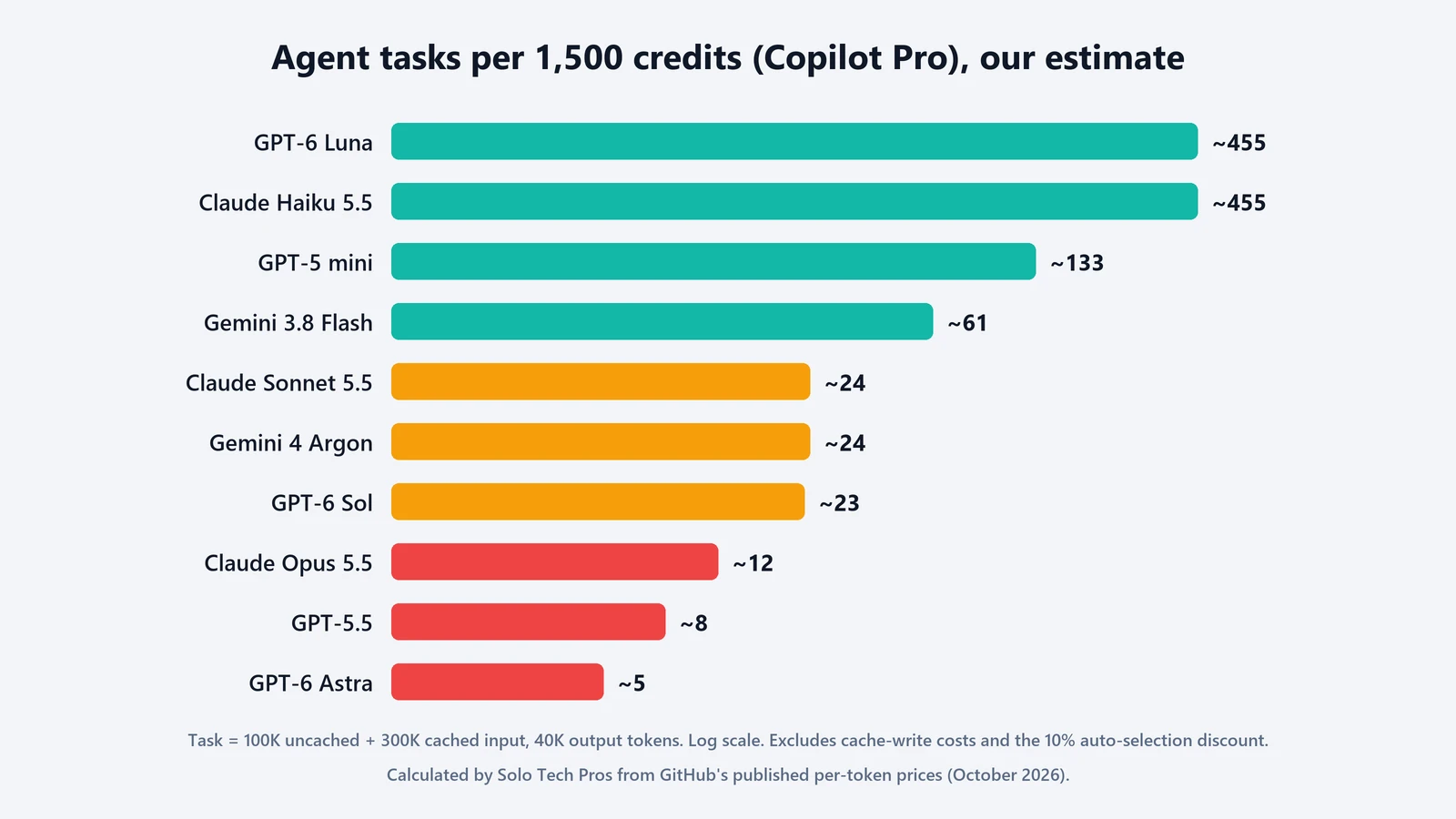
| Model | Chat question | Agent task | Agent tasks in 1,500 credits (Pro) | In 7,000 (Pro+) |
|---|---|---|---|---|
| GPT-6 Luna | 0.12 | 3.3 | ~455 | ~2,120 |
| Claude Haiku 5.5 | 0.12 | 3.3 | ~455 | ~2,120 |
| GPT-5 mini | 0.36 | 11.2 | ~133 | ~620 |
| Gemini 3.8 Flash | 0.90 | 24.8 | ~61 | ~280 |
| Claude Sonnet 5.5 | 2.40 | 63 | ~24 | ~111 |
| Gemini 4 Argon | 2.40 | 63 | ~24 | ~111 |
| GPT-6 Sol | 2.40 | 66 | ~23 | ~106 |
| Claude Opus 5.5 | 4.80 | 126 | ~12 | ~56 |
| GPT-5.5 | 6.40 | 185 | ~8 | ~38 |
| GPT-6 Astra | 12.00 | 330 | ~5 | ~21 |
Credits per task, rounded. The math is the input, cached input and output tokens, each multiplied by the model’s price per million tokens and converted at 1 credit = $0.01. Three caveats:
- Anthropic models and newer OpenAI models also charge a cache write cost, which we left out, so their real cost is somewhat higher.
- Some models have a long context tier with higher prices above a per-request threshold: 272K input tokens for most GPT models, 100K for Claude Haiku 5.5. We assumed every request stays under it.
- Paid plans get a 10% discount on model costs when you use automatic model selection in Chat, the CLI, the Copilot app or the cloud agent. We didn’t apply it.
The takeaway is the spread, not the exact numbers. On the same plan, choosing the model is worth a factor of 100 between the cheapest and the most expensive. A Pro allowance covers hundreds of agent tasks on a lightweight model, or a handful on a frontier one. Use the frontier models for the hard problem, not for every question.
If you’re still on an annual plan
GitHub says Pro and Pro+ subscribers on an existing annual plan stay on premium request billing until the plan expires, with their own table of model multipliers. GitHub’s announcement says those multipliers increased on June 1. Searches for “premium requests reset” or “multiplier” still apply to you, and the legacy docs are the ones to read. When the annual plan ends, you move to credits.
Check your usage and avoid surprises
- Update your editor and extension. GitHub lists minimum versions for accurate usage display, such as VS Code 1.120 and Visual Studio 2022 17.14.33. Older ones still work, but may show outdated billing terms or wrong prices.
- Watch the usage dashboard on GitHub.com, which shows your allowance and what you’ve used.
- Set a budget for additional usage only if you want Copilot to keep working past the allowance. The budget is in dollars and draws down at $0.01 per credit.
- Choose models deliberately. Copilot code review is the exception: GitHub says its model is picked automatically and not disclosed, and it also uses GitHub Actions minutes.
If the per-token math pushes you toward running models yourself, our guide to using Copilot CLI with local Ollama models covers that route and what it doesn’t keep local.