
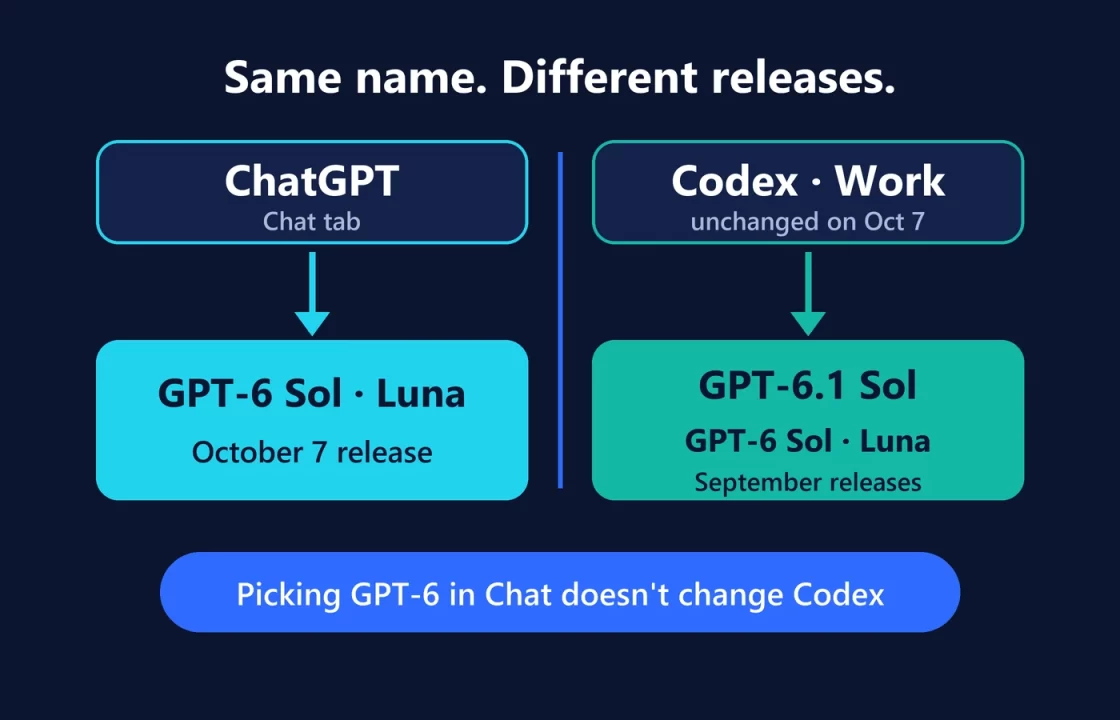
On October 7, OpenAI put GPT-6 in ChatGPT’s Chat tab. If you use Codex, you were already using GPT-6 before that. It just wasn’t the same release. OpenAI’s own system card for the launch says users of GPT-6 Sol and GPT-6 Luna in Codex and ChatGPT Work “are still using previously released versions,” and it labels the two by month: October for the new ChatGPT models, September for the ones that stay in Codex and Work. Codex also has GPT-6.1 Sol, which the Chat tab doesn’t.
Same model names, different releases. Here’s what changed where, and what it means if you write code with these tools.
What changed in ChatGPT on October 7
According to OpenAI’s announcement and the ChatGPT release notes:
- GPT-6 arrives in the Chat tab with Intelligent UI, which lets answers include interactive elements like comparisons, diagrams and small tools.
- Plus, Pro, Business and Enterprise get GPT-6 Sol; Free and Go get GPT-6 Luna. OpenAI says both “are tuned for everyday conversation.”
- The rollout started on October 7 for paid plans and expands to Free and Go from October 8. Enterprise availability depends on admin settings.
- GPT-6 can start answering while it’s still thinking or using tools, then add findings without another prompt.
- The Pro reasoning option keeps using GPT-6 Astra and doesn’t support Intelligent UI.
The system card adds that these models replace GPT-5.6 Sol and GPT-5.6 Luna in ChatGPT.
What changed in Codex, and when
Codex got GPT-6 two weeks earlier, and has moved on since:
- September 22: GPT-6 Sol and GPT-6 Luna arrive in ChatGPT Work and Codex. The release note at the time said they were “separate from the models available in Chat.”
- September 29: GPT-6.1 Sol starts rolling out in Work and Codex, beginning with Pro and expanding to Plus, Business, Enterprise and Edu. OpenAI describes it as an improvement on GPT-6 Sol “in agentic coding, computer use, and professional work.”
- October 7: nothing. OpenAI’s announcement says it plainly: “The models powering Work and Codex are not changing as part of this release.”
- October 8: faster steering in Codex in the ChatGPT desktop app, so follow-ups can redirect a running task sooner, and, per the Codex changelog, an Ultrafast mode for GPT-6.1 Sol on Pro $500 and eligible Enterprise and Edu plans.
The difference at a glance
Status as of October 8, 2026, from OpenAI’s release notes, help center and Codex documentation.
| Surface | GPT-6 models now | What changed | What didn’t | Who it’s for |
|---|---|---|---|---|
| ChatGPT Chat (Plus, Pro, Business, Enterprise) | GPT-6 Sol (October); GPT-6 Astra for Pro reasoning | Oct 7: GPT-6 with Intelligent UI replaces GPT-5.6 Sol | Pro reasoning stays on Astra | Everyday chat on paid plans |
| ChatGPT Chat (Free, Go) | GPT-6 Luna (October) | From Oct 8: replaces GPT-5.6 Luna | n/a | Everyday chat on free plans |
| Codex (desktop app, CLI, IDE, Cloud) | GPT-6.1 Sol; GPT-6 Sol and Luna (September); GPT-6 Astra | Sep 22: GPT-6; Sep 29: 6.1 Sol; Oct 8: faster steering, 6.1 Sol Ultrafast | Not changed by the Oct 7 release | Software development |
| ChatGPT Work | Same models as Codex | Same timeline as Codex | Not changed by the Oct 7 release | Longer, multi-step tasks and deliverables |
| OpenAI API | gpt-6-sol, gpt-6-luna (Sep 22), gpt-6.1-sol (Sep 29); chat-latest alias |
Oct 7: chat-latest updated to ChatGPT’s latest model |
The named model IDs | Developers building on the API |
Why two products can both say “GPT-6”
“GPT-6 Sol” is a model family name, not a single fixed file. OpenAI has shipped two releases under that name about two weeks apart: the September versions for Codex and Work, and the October versions, which it says are “tuned for everyday conversation,” for Chat. The system card is the clearest statement of this, which is why it distinguishes the models “by their month of release.”
OpenAI’s documentation doesn’t always make it easy to see. The help article on ChatGPT Work and Codex says GPT-6.1 Sol, GPT-6 Sol and GPT-6 Luna “are not available in regular ChatGPT conversations,” while the October 7 release note says the Chat tab now uses GPT-6 Sol and GPT-6 Luna. Read alongside the system card, both can be true: the Codex and Work releases aren’t in Chat, and the Chat releases aren’t in Codex. But the shared names make it easy to assume otherwise.
Does picking GPT-6 in ChatGPT change Codex?
No. Codex has its own model picker, and OpenAI’s help says “Codex keeps the model you selected manually.” For workspaces, admins set a starting model for Work and Codex separately from Chat, and changing one doesn’t change the other.
The same goes for impressions. If GPT-6 feels different in Chat, that tells you about the October conversational release. It doesn’t tell you how the model you use in Codex behaves on your codebase.
What developers should actually do
- Pin the model you mean. In the Codex CLI, use
codex -m gpt-6.1-sol(or/modelin a session). The desktop app, CLI and IDE extension shareconfig.toml, wheremodel = "gpt-6.1-sol"sets your default. OpenAI’s Codex models page recommends GPT-6.1 Sol for complex coding and agentic work, and Luna for focused, repeatable tasks. - Replace GPT-5.5 before October 14. The same page says GPT-5.5 retires from ChatGPT, Work and Codex on October 14, 2026, and stays available in the API. Update workspace defaults, saved settings, custom agents, scheduled tasks and scripts that still select it.
- Don’t build on
chat-latest. In the API, the October ChatGPT model is reachable through thechat-latestalias, which OpenAI says “points to the latest model available in ChatGPT” and “will be regularly updated.” OpenAI recommends the GPT-6 model family for production andchat-latestfor testing chat improvements. - Rerun image-input evals if you ran them in September. On September 25, OpenAI’s API changelog recorded a fix for “a bug in image encoding that degraded image understanding in GPT-6 Sol and GPT-6 Luna,” affecting visual tasks in the API and Codex, and recommended rerunning evaluations.
- Judge on your own tasks. The system card does compare the two releases, but on safety: for example, it reports the October models have “slightly lower point estimates than their September counterparts on multi-turn jailbreak robustness, with broadly overlapping 95% confidence intervals.” It doesn’t include a coding comparison between them, and we haven’t run one. Compare them on the work you actually do.
The short version: GPT-6 in ChatGPT is the October release. Codex and Work run the September release and GPT-6.1 Sol, and they didn’t change on October 7.